
Latest Column | ‘Truth Is Not Optional’ (October 2026)
October 1, 2026
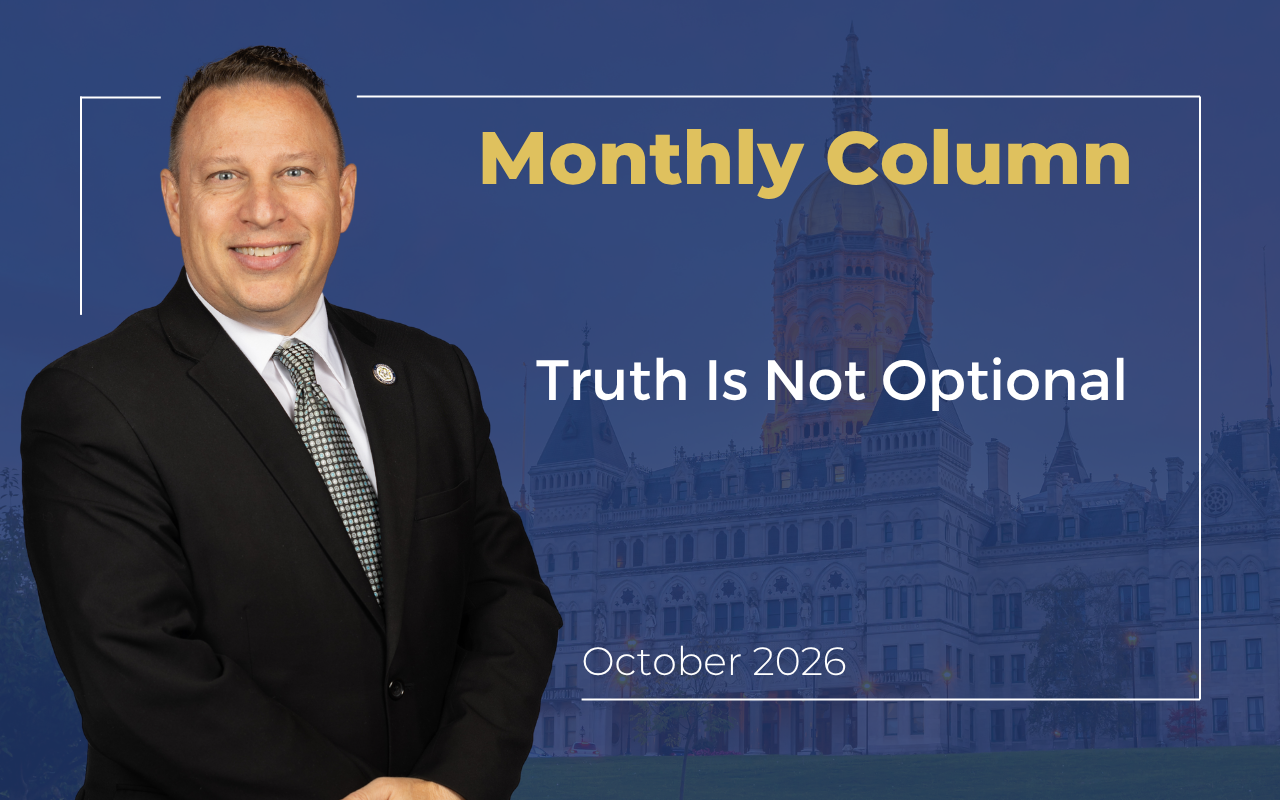
By State Sen. Rob Sampson
Election season can have a way of reducing people to labels.
I’m not talking about everyone. Most people can judge others as individuals. But our political culture increasingly encourages something less thoughtful. Turning party affiliation into something it was never meant to be: a substitute for judging candidates.
Once we allow those labels to substitute for thinking, it becomes easy to stop listening. We decide what someone believes before they speak, assign them responsibility for things they never said or did, and accept negative claims about people we dislike without asking whether those claims are even true.
That is dangerous in a country that depends on citizens making informed decisions.
I am a Republican because of the principles that brought me into public service: freedom first, limited and accountable government, personal responsibility, local control, and the belief that government exists to serve the people, not the other way around.
But being a Republican does not mean I agree with every Republican about everything, or that I should be judged by every word or action of the President. I apply the same standard to Democrats. I do not assume every Democrat is Joe Biden, Kamala Harris, Barack Obama, or anyone else.
I understand strong feelings about national politics. But I think there is a problem when those feelings become a substitute for evaluating the person actually on the ballot.
It also creates an odd political trap. A state or local candidate who shares a party label with a controversial national figure can be pushed into a debate that has very little to do with the office he actually holds: defend that national figure and alienate people who dislike him or attack him and alienate people who support him.
Neither choice tells voters much about how that person has or will represent them.
I want to know what that individual believes. What have they done? How have they voted? What principles guide them?
That sounds simple, we are increasingly encouraged to do the opposite. We are told whom to hate first and what they supposedly believe second.
I would rather reverse that process.
Look at the person. Look at the record. Listen to the argument. Then decide.
That does not mean abandoning strong convictions. I have plenty. I strongly oppose the concentration of political power in Hartford and believe Connecticut benefits from a vigorous opposition, regardless of which party controls government. Today, Democrats hold the governorship and majorities in both chambers of the General Assembly. I disagree profoundly with many policies that have emerged from that arrangement, particularly those I believe have contributed to Connecticut’s affordability problems.
But disagreement does not require hatred, and partisanship should never make truth optional. I don’t have to look very far for examples of why that distinction matters. My own race is a perfect example.
My opponent has circulated campaign material portraying me as “lobbying” for Eversource, refusing to suspend the gas tax, against lowering the cost of living, supportive of Connecticut’s data-center corporate welfare incentives, and finally reducing the price of insulin.
The problem is that those claims are utterly and demonstrably false.
I introduced legislation to eliminate the hidden taxes on electric customers and reduce electric bills. When Connecticut suspended its 25-cent gasoline tax in 2022, I voted yes; the Senate vote was 33-0. The 2021 bill creating substantial tax incentives for qualifying data centers was HB 6514. I voted no.
Even the insulin claim demonstrates why context matters. Sure, I voted against HB 6003. I have never denied that. The bill claimed to cap costs but only for certain plans. During the actual debate, I explicitly said I favored lower insulin prices and argued that the bill did not address the underlying price and would shift costs elsewhere. I even predicted on the Senate floor that the vote would someday become a campaign flyer saying, “Senator Sampson votes against reduced insulin prices.”
People are entirely free to disagree. That’s politics.
But arguing against someone’s actual position is different from inventing one for them.
I raise these examples not because I feel a need to defend myself, but because the conduct of a campaign is itself something voters are entitled to evaluate.
If you think a candidate made a bad decision, fine. Tell voters what they did and make the argument. If their reasoning is poor, expose it. If there is a better policy, propose it.
But the public record should be the starting point.
The same principle applies to claims that I do not help my communities secure state funding because I rarely advertise it. The record shows otherwise, including numerous projects where my support is documented. These efforts are collaborative, and I do not claim sole credit.
When local leaders ask me to support worthwhile projects, I help. What I generally do not do is hold a press conference afterward and pretend taxpayer money became mine because I helped return some of it to the community. That is a difference in philosophy and style, not an absence of work.
People will argue. We will disagree about taxes, spending, education, public safety, energy and the proper role of government. Good. Those debates are necessary.
What concerns me is when dislike of a political party or personality becomes so consuming that facts no longer matter.
That is when we surrender our own judgment.
Most people I meet are not political caricatures. They are parents, workers, business owners, seniors, taxpayers and neighbors trying to build decent lives. They may vote differently and see the world differently. That does not make them enemies.
I trust voters enough to tell them what I believe, explain my votes, and let them make their own judgment. I try to extend the same courtesy when describing the views and records of people I oppose.
Every candidate should be held to that standard.
So as another election approaches, perhaps the most useful question is not, “Which team is this person on?”
Ask instead:
Is what I am being told true?
Digital receipts
2023 CGA record — Sampson electric-rate/Public Benefits Charge proposals
2022 HB 5501 — gas-tax suspension roll call and bill record
2021 HB 6514 — data-center incentives and Senate vote
2020 Senate transcript — insulin debate
2026 SB 1 Republican alternative, LCO 5764
OFA fiscal note on LCO 5764