
Sen. Sampson Joins Senate & House Republicans Calling for Connecticut Government’s ‘Candy Store’ to Close
February 19, 2026
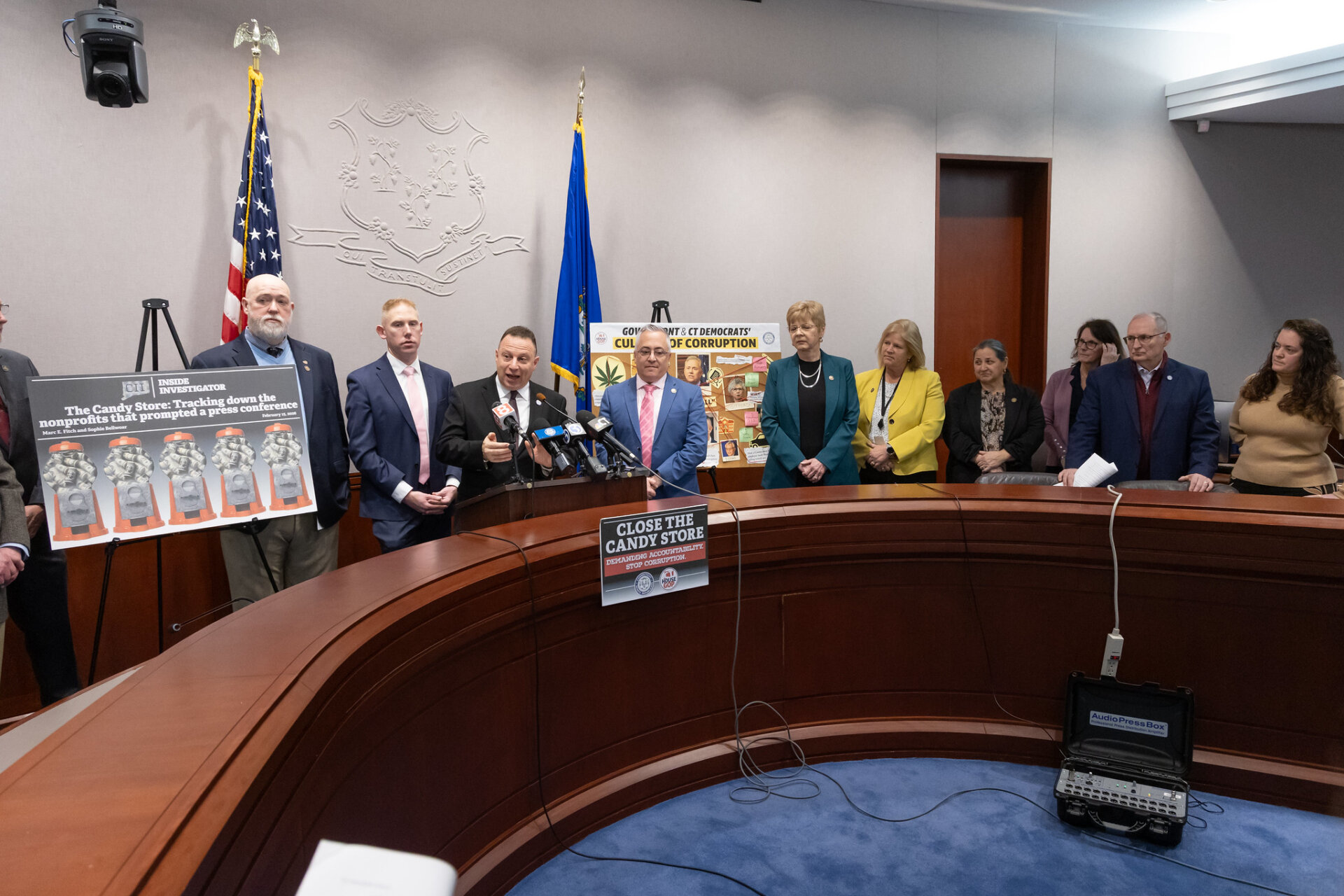
Sen. Sampson Joins Senate & House Republicans Calling for Connecticut Government’s ‘Candy Store’ to Close
Unveil Anti-Corruption, Accountability Solutions to Combat Waste, Fraud and Abuse
(Watch the press conference here.)
HARTFORD — State Sen. Rob Sampson (R–16) joined fellow Senate and House Republicans today in unveiling legislative proposals aimed at delivering accountability, preventing fraud and waste, and rooting out what they describe as a growing culture of corruption in Connecticut state government.
“I will start the same way I did last week when we discussed affordability the people of Connecticut are struggling,” Sen. Sampson said. “Families are paying among the highest taxes in the nation. Energy costs are through the roof. Inflation has eroded savings and made basic necessities more expensive. And while families tighten their budgets, state government continues to expand spending more money with less transparency and less accountability.”
Sen. Sampson pointed to a pattern of integrity failures that have emerged in recent years under long-standing one-party control of the Governor’s Office and the General Assembly.
“These are not partisan talking points. They are matters of public record,” Sen. Sampson said.
Among the examples cited:
- A former senior state official in charge of school construction grants was convicted on federal charges including bribery tied to public projects.
- Public audits and federal subpoenas have raised serious concerns about nonprofit grant funding connected to sitting lawmakers.
- Reporting has detailed questionable spending practices and internal control weaknesses within the state university system.
- A Superior Court judge ordered a new Democratic mayoral primary in Bridgeport after finding serious absentee ballot irregularities.
“When repeated failures occur under consolidated political control, responsibility follows power,” Sen. Sampson said. “Oversight weakens. Internal accountability becomes political. And transparency becomes optional.”
Sen. Sampson also referenced the February 2025 emergency-certified spending bill that included millions of dollars in legislatively directed earmarks.
“On the Senate floor, I asked simple questions: Who requested these funds? What criteria were used? Where is the documentation? Those questions went unanswered,” Sen. Sampson said.
“Investigative reporting later confirmed what many of us warned about — millions distributed through a process that functioned like a ‘candy store,’ where transparency was limited and documentation was scarce.”
Sen. Sampson emphasized that the issue is not whether individual nonprofits perform good work.
“This is about process,” Sen. Sampson said. “Public money must be distributed through a fair, transparent, and accountable system. Every dollar that lacks transparency is a dollar taken from families who are already stretched thin.”
Republicans are proposing the following anti-corruption legislative reforms:
Establish Standards for Third-Party Funding Recipients, Vetting for Bonding and Budget Requests
- Require all budget and bonding earmark requests to be publicly linked to the legislator or organization making the request before funds are granted, including a certification that the requesting legislator, their family members, or any associated business has no financial interest in or will benefit from the grant.
- Mandate that organizations receiving state budget funds or bond funds disclose how money will be spent, including the share dedicated to administration versus programming, the number of people served, program goals and progress, and a detailed Return on Investment (ROI) analysis.
- Require financial statement filings, a full accounting of all income sources and disbursements, disclosure of any officer or board member convictions related to financial crimes or fiduciary breaches, and full disclosure of any close associations with current legislators, government staff, or other elected officials.
- Require that when grant recipients pass funds to third-party or subsequent recipients, those recipients must identify all such parties, the specific amounts granted, and be bound by the same transparency and reporting requirements as the original recipient.
- Direct state agencies responsible for disbursing these funds to report annually on fund status and usage, and subject grant recipients to random state audits to verify funds are used as intended.
Establish an Office of Inspector General (Civil)
- Will investigate fraud, waste and abuse in the expenditure or use of state resources.
- Review Auditors’ reports on Agencies and investigate findings of fraud, waste and abuse.
- Intake complaints, including from whistleblowers.
- Seek civil recovery of funds.
- Refer cases to state/federal authorities.
Strengthen Oversight and Empower the State Auditors
- Require physical site visits for housing and human services providers receiving $25,000 or more in state funds
- Set performance and accountability standards in order for state agencies to be able to renew contracts
- Require additional review of findings identified in audits where only a sample of transactions were reviewed
- Grant subpoena power to the Auditors of Public Accounts.
Restore the bipartisan Legislative Program Review and Investigations Committee
- Connecticut once had a powerful, bipartisan watchdog committee that held state government accountable — independently investigating agency performance and uncovering waste and mismanagement.
Treasurer Fiduciary Reform
- Establish an Investment Board to share fiduciary responsibility with the state treasurer for state investment.
Housing Funding Reform
- Require the Department of Housing (DOH) to identify specific projects and terms of any agreements to the state Bond Commission prior to receiving allocations of state bond funds.
- Require DOH and CHFA to compile and report dollars loaned and leveraged for housing projects and the process and “scorecard” for each project that led to an award.
Require FOIA/UAPA training for PURA Commissioners and Staff
- Requiring commissioners and staff to undergo training on the Freedom of Information Act and the Uniform Administrative Procedure Act — the laws governing public records and agency conduct — ensures those entrusted with regulating Connecticut’s utilities follow the rules.
Deposit volatility funds in a timely matter
- Connecticut’s volatility cap fund exists to protect taxpayers. Recent actions by the State Treasurer to withhold the deposit of these funds exposed a dangerous loophole. Require the Treasurer to deposit volatility funds within 30 days, ensuring these reserves are managed with integrity.
Provide House and Senate minority leaders appointments to Siting Council
“If there is nothing to hide, there should be no resistance to sunlight,” Sen. Sampson said. “These reforms are not radical. They are basic safeguards.”
Sen. Sampson concluded by emphasizing that the reform package is structural not partisan.
“I am not accusing every member of wrongdoing,” Sen. Sampson said. “But when one party controls every lever of power for decades, and repeated failures occur, accountability becomes essential. Connecticut families work too hard to fund a system that protects insiders while they shoulder the burden.”
“The ‘Candy Store’ must close,” Sen. Sampson said. “It is time to restore transparency, accountability, and public trust.”