
Sen. Gordon Stands up for Taxpayers and Government Transparency during Senate Debate on Opening Day
February 6, 2026
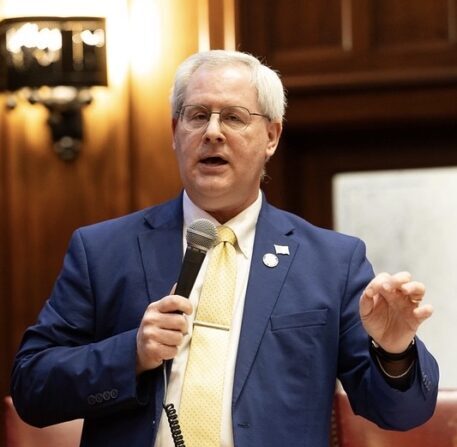
HARTFORD, CT — State Senator Jeff Gordon (R–Woodstock) stood strong for the taxpayers of the 35th District and Connecticut, and for the core democratic principles of government accountability, transparency, and the public’s constitutional right to representation by their elected officials. He strongly stood against government overreach, behind-the-scenes use of taxpayer money, and the concentration of spending authority in the hands of a single individual (the Governor) without public input and legislative oversight.
Senate Bill 83 created an off budget “emergency” fund and ceded legislative control to the Governor over how to spend more than $330 million of public funds. This “emergency”, which is politically stated to be due to uncertainties of federal funding, would be in place until June 30th, 2027. It follows on a preceding “emergency” fund of $500 million created several months ago in a special session without public input. That fund expired on February 4th when the legislative session started. Approximately $170 million had been spent by the Governor without a proper audit and accounting of what was spent, who got the money, and if it was spent properly. S.B. 83 took the unspent money (more than $330 million) and swept it into a new “emergency” fund.
S.B. 83 had no public hearing, no requests for public input, minimal public notice, and no review by legislative committees. It allows the Governor, while he runs for re-election, to unilaterally spend it for any reason without the Legislature voting at any time to approve each expenditure.
“Delegating sole authority over the expenditure of huge amounts of taxpayer dollars to one person (the Governor), especially while the legislature is in session and can make such deliberative decisions, and especially without public hearings, is bad public policy,” Senator Gordon said. “It undermines the very foundations of representative democratic governance, and proper checks and balances.”
Senator Gordon emphasized that public funds belong to the people who pay taxes and must be handled with transparency, accountability, and meaningful oversight.
“Sound fiscal policy depends on shared responsibility,” Gordon said. “When spending decisions are made behind closed doors by one individual, the public loses its seat at the table, and public trust is eroded, regardless of anyone’s intentions. It allows special interests to prevail over public interests. It is ripe for abuse. Recently, we have seen big examples of fraud, with taxpayer money going to organizations that do not exist, to people who lined their pockets, and federal and state investigations into corruption.”
One of the central concerns raised by Senator Gordon was the absence of public hearings. He noted that public hearings are a critical safeguard in a representative democracy that allow citizens, stakeholders, and legislators to ask questions, raise concerns, and provide input before decisions are made by the Legislature and taxpayer money is authorized to be spent.
“Public hearings are not a procedural inconvenience; they are a cornerstone of democracy,” Gordon said. “Skipping that process sends a clear message to taxpayers that their voices don’t matter, and that breeds mistrust and misdeeds.”
Senator Gordon also pointed out that bypassing the legislative process is especially troubling while the General Assembly is actively in session.
“When the legislature is in session, there is no justification for sidelining the people’s elected representatives,” he said. “Lawmakers are present, accountable to their constituents, and ready to debate spending in the open. Going around that process isn’t about efficiency; it’s about avoiding scrutiny. It makes the Legislature less than a coequal branch of government. That is wrong and not how government should work.”
Sen. Gordon added, “Good government doesn’t hide. Taxpayer money should be decided in the daylight, with public input and shared responsibility. Anything less is blatantly unfair to the people paying the bill.”
“I voted No on S.B. 83, not because of the merits of any particular program the money might be spent on, but because of the outright bad, off-budget, behind-the-scenes, unregulated process it created, shutting out public input and legislative decision-making,” said Sen. Gordon. “I voted against bad government. I voted for the taxpayers of the 35th District and Connecticut.”
Senator Gordon debated two amendments for S.B. 83. Amendment A would have returned the more than $330 million back to taxpayers in the form of rebates. Sen. Gordon highlighted that people are over-taxed. They deserve their money back to them as they and their families deal with the high cost of living and energy in Connecticut. Amendment B would have restored proper legislative oversight via debates, public input, and affirmative votes by the Legislature before any money is spent. Neither of the common-sense amendments passed on party-line votes.